Shivam Pokhriyal

pay per call vs form leads

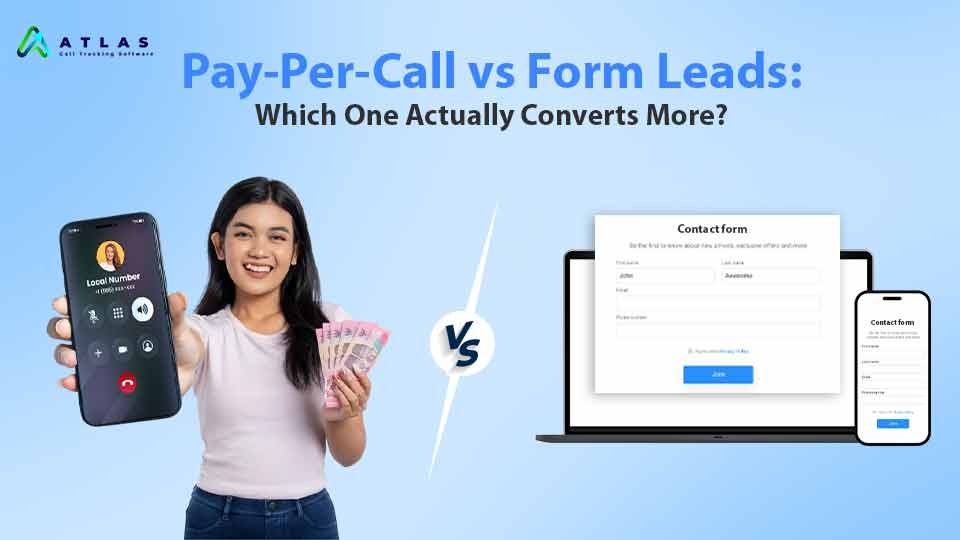
Pay-Per-Call vs Form Leads: Which One Actually Converts More?

In digital marketing, leads are everything. But not all leads are created equal. Some fill out a form.Some pick up the phone. And if you’ve ever managed campaigns, handled sales calls, or chased unresponsive form submissions — you already know there’s a big difference. So let’s settle the debate: Pay-Per-Call vs Form Leads — which one actually converts more? First, Let’s Define the Two 📞 What Is Pay-Per-Call? Pay-Per-Call is a performance marketing model where advertisers pay only for qualified inbound phone calls. These calls are typically driven by: Instead of paying for clicks or form submissions, you pay for real conversations. 📝 What Are Form Leads? Form leads are generated when a user fills out an online form with their name, email, phone number, and other details. These are usually followed by: Forms are common because they’re easy to implement. But ease doesn’t always equal effectiveness. The Real Difference: Intent Here’s where things get interesting. When someone fills out a form: When someone calls: A phone call requires effort.And effort signals intent. That intent is what drives higher conversion rates. Let’s Talk Numbers (Industry Reality) While conversion rates vary by industry, the general pattern is clear: Why? Because call leads are usually bottom-of-funnel. Industries where calls dramatically outperform forms: When urgency and money are involved, people prefer talking over typing. Why Pay-Per-Call Converts Better 1️⃣ Immediate Human Connection A form can’t: A live call can. Sales psychology proves that voice builds trust faster than text. Tone, confidence, reassurance — all happen in real time. That shortens the sales cycle. 2️⃣ Faster Response = Higher Close Rate With form leads: With pay-per-call: Speed wins sales. 3️⃣ Higher Lead Quality Form leads often include: Inbound calls?Almost zero fake intent. If someone calls, they’re real. And when you’re paying per qualified call, filtering (duration, geo, IVR routing) improves quality even further. 4️⃣ Better ROI on High-Ticket Offers If your average sale is: Then a high-converting phone call can easily justify higher acquisition costs. Pay-Per-Call thrives in industries where: Forms often work better for low-ticket or self-serve products. But Are Form Leads Useless? Not at all. Forms work well for: They are excellent for scaling volume. But volume doesn’t always mean revenue. The real question isn’t:“Which generates more leads?” It’s:“Which generates more sales?” And that’s where Pay-Per-Call often wins. Conversion Breakdown: Real-World Funnel Example Let’s imagine 1,000 visitors. Form Funnel: Final conversion: 1% of total traffic Pay-Per-Call Funnel: Final conversion: 2% of total traffic Even with fewer total leads, revenue doubles. This is why many performance marketers are shifting budgets toward call-driven funnels. The Psychological Advantage of Calls Here’s something marketers often overlook: People call when they are emotionally ready. They call because: Forms are passive. Calls are active. And active buyers convert. When Form Leads Might Win To be fair, there are situations where forms outperform calls: But when deals require persuasion, customization, or consultation — conversations outperform submissions. The Smart Strategy: Use Both The real winners don’t choose one. They design funnels like this: They: This hybrid approach captures every type of buyer. So, Which One Actually Converts More? If we’re talking pure closing power? 👉 Pay-Per-Call usually converts higher. If we’re talking volume and automation? 👉 Forms scale easier. But if your goal is revenue — not vanity metrics — calls often deliver stronger ROI. Because at the end of the day: Forms collect data.Calls close deals. Final Thoughts: Follow the Revenue, Not the Trend Marketing is full of trends. Chatbots.Automation.AI forms.One-click funnels. But human conversation still wins when money is on the line. If your business depends on high-quality, high-intent leads, it might be time to ask: Are you optimizing for submissions…Or for sales? Because when the phone rings with a qualified prospect, that’s not just a lead. That’s opportunity. 📞 And opportunity converts.

Pay-Per-Call vs Form Leads: Which One Actually Converts More? Read More »

What Is Inbound Call Lead Generation and Why It Converts Better Than Forms

What Is Inbound Call Lead Generation and Why It Converts Better Than Forms

Imagine this. A customer is ready to buy.They have questions.They want reassurance.And instead of filling out a boring form and waiting… they pick up the phone. That moment—when the phone rings—is where inbound call lead generation wins. Let’s break down what it really is, why it works so well, and why businesses that rely only on forms are leaving serious money on the table. What Is Inbound Call Lead Generation? Inbound call lead generation is a marketing strategy where potential customers call your business directly after seeing your ad, landing page, website, or listing. These calls can come from: Instead of submitting a form, the lead calls you—already interested, already engaged. 📞 A call = intent.A form = curiosity. Big difference. Why Inbound Calls Are High-Intent Leads When someone fills a form: But when someone calls: That’s why inbound call leads are considered sales-ready leads, not just marketing leads. Why Inbound Calls Convert Better Than Forms Let’s talk real numbers and real behavior. 1. Calls Build Instant Trust A form can’t answer questions.A form can’t handle objections.A form can’t reassure a hesitant buyer. A human conversation can. On a call, your team can: That trust translates directly into higher conversions. 2. Calls Capture Buyers at the Decision Stage People don’t usually call for fun. They call when: Inbound calls often come from the bottom of the funnel, where conversion rates are naturally higher than form fills. 3. Forms Create Friction. Calls Remove It. Let’s be honest. Forms: Calls: One click. One ring. One conversation. That simplicity boosts conversions—especially on mobile. 4. Calls Convert Better for High-Value & Urgent Services Inbound call lead generation works exceptionally well for: When money or urgency is involved, people prefer to talk. 5. Calls Give You Better Lead Quality A form can be fake.A call can’t be. With inbound calls: This means: Inbound Call Lead Generation vs Form Leads Feature Inbound Calls Form Leads Intent Level Very High Medium to Low Speed Instant Delayed Trust Human Interaction Automated Lead Quality Strong Mixed Conversion Rate Higher Lower Sales Effort Easier Follow-up heavy Why Smart Marketers Are Shifting to Call-Driven Funnels Modern buyers want: That’s why brands are: Inbound call lead generation isn’t replacing forms—it’s outperforming them where it matters most. How Call Tracking Makes Inbound Calls Even More Powerful To scale inbound call lead generation, businesses use call tracking to: With proper tracking, inbound calls become measurable, optimizable, and scalable—just like digital leads. Final Thoughts: If the Phone Rings, Revenue Follows Forms collect information.Calls close deals. Inbound call lead generation works because it aligns with human behavior—people talk when they’re serious. If your business depends on quality leads, faster conversions, and real conversations, inbound calls aren’t optional anymore—they’re essential. And when your phone rings with the right lead at the right time?That’s not luck. That’s smart marketing. 🚀📞

What Is Inbound Call Lead Generation and Why It Converts Better Than Forms Read More »

15 Facebook Ads updates in 2025

15 Facebook Ads Updates in 2025 Every Marketer Should Know

Facebook advertising continues to evolve rapidly, and 2025 marks a major shift in how marketers plan, launch, and optimize campaigns. With Meta pushing deeper into AI-driven automation, privacy-first tracking, and outcome-based optimization, advertisers can no longer rely on old playbooks. From smarter Ads Manager workflows to predictive performance insights, today’s Facebook advertising ecosystem demands a stronger focus on creative quality, first-party data, and real business results. Understanding the Facebook Ads Updates in 2025 is critical for marketers who want to stay competitive, control ad spend, and drive consistent conversions in an increasingly automated environment. This guide breaks down the most important changes every marketer needs to understand and apply. Here is the detailed explanation of 15 Facebook Ads Updates in 2025 1. AI-Powered Campaign Setup Becomes the Default in Ads Manager In 2025, Facebook (Meta) has pushed AI-driven campaign creation to the center of Ads Manager. When creating a new campaign, advertisers now see “Advantage+ Guided Setup” as the default flow. What changed: What marketers should do: 👉 Best for: Lead gen, ecommerce, app installs, and scaling campaigns👉 Risk: Less control for beginners who don’t review settings carefully 2. Advantage+ Audiences Replace Traditional Detailed Targeting Facebook Ads 2025 has reduced dependency on interest-based targeting. Instead, Advantage+ Audience is now strongly recommended—even for cold traffic. What changed: Inside Ads Manager: What marketers should do: 👉 Winning strategy in 2025 = Less targeting, better creatives You can Also Read : 15 Latest Google Ads Updates in 2026 You Need to Know 3. Conversion Tracking Shifts to Event Quality Over Quantity Meta now prioritizes event quality instead of firing multiple low-value events. What changed: Key updates in Events Manager: What marketers should do: 👉 This makes lead quality tracking more important than ever in 2025 4. New Creative Performance Breakdown Inside Ads Manager Creative analytics in 2025 are far more detailed and AI-driven. What changed: Example insights you’ll see: What marketers should do: 👉 In 2025, creative is the biggest targeting lever 5. Budget Optimization Moves to Campaign-Level AI Control Facebook Ads 2025 pushes advertisers toward fully automated budget allocation. What changed: Inside Ads Manager: What marketers should do: 👉 Best results come from stable budgets + strong signals 6. Ads Manager Introduces Predictive Performance Forecasting In 2025, Ads Manager now includes AI-based performance forecasting, helping marketers predict outcomes before spending heavily. What changed: Where you see this: What marketers should do: 👉 This reduces guesswork and improves ROAS planning 7. Automated Creative Variations Replace Manual A/B Testing Facebook Ads 2025 relies heavily on AI-generated creative variations. What changed: Inside Ads Manager: What marketers should do: 👉 Faster testing, but brand control is still your responsibility 8. Lead Ads Get Smart Qualification Filters Lead Ads in 2025 focus on quality over volume. What changed: New features include: What marketers should do: 👉 Lower lead volume, higher conversion rate 9. Call & Message Ads Receive Priority Placement Facebook Ads 2025 gives higher delivery priority to call and message-driven ads, especially for local and service businesses. What changed: Inside Ads Manager: What marketers should do: 👉 Ideal for real estate, healthcare, agencies, and local services 10. Privacy-First Targeting With Expanded First-Party Data Use Privacy regulations continue shaping Facebook Ads in 2025. What changed: Inside Events Manager: What marketers should do: 👉 First-party data is the foundation of performance in 2025 11. Reels Ads Become the Primary Placement by Default In 2025, Reels Ads are no longer optional—they’re the top-performing and default placement across many campaign types. What changed: Inside Ads Manager: What marketers should do: 👉 Reels is now Meta’s highest-priority inventory 12. AI-Generated Ad Copy & Visual Suggestions Built Into Ads Manager Facebook Ads Manager in 2025 includes native AI content generation for ads. What changed: Inside Ads Manager: What marketers should do: 👉 AI speeds up creation, but strategy still matters 13. Frequency & Creative Fatigue Alerts Go Real-Time Ad fatigue detection is smarter and faster in 2025. What changed: New alerts include: What marketers should do: 👉 Fatigue control directly impacts ROAS 14. Simplified Reporting With Business Outcome Metrics Facebook Ads reporting in 2025 focuses more on real business impact, not vanity metrics. What changed: Inside Ads Manager: What marketers should do: 👉 Reporting is now decision-focused, not data-heavy 15. Smarter Scaling With AI Stability Signals Scaling in 2025 is more controlled and data-driven. What changed: Inside Ads Manager: What marketers should do: 👉 Stable campaigns scale better than aggressive ones Conclusion Facebook Ads in 2025 are no longer just about targeting the right audience—they’re about feeding the right signals to AI, delivering high-quality creatives, and measuring outcomes that truly impact business growth. As Ads Manager becomes smarter and more automated, marketers who adapt quickly will gain a significant advantage, while those who resist change may see performance decline. By embracing AI-powered optimization, prioritizing first-party data, monitoring creative fatigue, and focusing on meaningful conversions, brands can turn complexity into opportunity. Mastering these Facebook Ads Updates in 2025 isn’t optional anymore—it’s essential for building scalable, high-performing campaigns that succeed in the new era of digital advertising. Frequently Asked Questions

15 Facebook Ads Updates in 2025 Every Marketer Should Know Read More »

15 Google Ads Updates in 2026

15 Latest Google Ads Updates in 2026 You Need to Know

Google Ads is entering a defining era. What once revolved around keywords, manual bidding, and incremental optimizations has now evolved into a system powered by artificial intelligence, predictive modeling, and privacy-first measurement. In 2026, advertisers are no longer just managing campaigns—they are training algorithms with data, signals, and outcomes. These changes affect every aspect of advertising: how campaigns are structured, how audiences are reached, how conversions are measured, and how success is defined. Automation is deeper than ever, control is more abstract, and visibility into performance is increasingly dependent on the quality of data advertisers provide to Google’s systems. This shift creates a clear divide. Advertisers who understand the platform’s new direction can scale faster and more efficiently, while those relying on outdated tactics risk wasted spend and poor lead quality. That’s why understanding the 15 Latest Google Ads Updates in 2026 isn’t optional—it’s essential for staying competitive. This three-part series breaks down the most important changes shaping Google Ads today, covering AI and automation, privacy and measurement, and finally creatives, user experience, and revenue optimization. Together, these updates reveal where Google Ads is heading—and how advertisers must adapt to succeed. Here is the detailed description about the 15 Google ads new updates for 2026 1. Google Ads Becomes Fully AI-First In 2026, Google Ads officially transitions to an AI-first platform, where automation is no longer optional—it is the default. From campaign creation to optimization, Google’s AI now handles: Manual levers still exist, but they function more as guidance signals rather than direct controls. What this means for advertisers: Advertisers must focus less on micromanagement and more on providing high-quality inputs—strong creatives, clear conversion goals, and accurate performance data. 2. Performance Max Dominates Account Structures Performance Max (PMax) campaigns are now the primary campaign type recommended for most accounts. Google continues to consolidate Search, Display, YouTube, Discover, Gmail, and Maps into a single AI-driven campaign. Key changes in 2026: Challenge: While reach increases, visibility into channel-level performance decreases, making external measurement tools increasingly important. 3. Search Keywords Are Replaced by Intent Signals Traditional keyword matching takes a back seat as Google Ads relies more heavily on: Exact and phrase match still exist, but they now behave more broadly than ever. Impact: Advertisers must monitor lead quality, not just search term reports. 4. Auto-Generated Ads Become the Standard By default, Google now creates: These assets are dynamically mixed and matched based on predicted performance. Best practice in 2026: Instead of fighting automation, advertisers should: 5. Predictive Smart Bidding Goes Real-Time Smart Bidding no longer reacts to past performance alone. In 2026, it predicts: This allows Google Ads to adjust bids before demand spikes, not after. Key takeaway: Bidding success now depends on the quality of conversion data you feed into the system—not manual bid tweaks. 6. Third-Party Cookies Are Fully Eliminated By 2026, third-party cookies are completely phased out across Chrome and the wider Google ecosystem. This marks the end of traditional cross-site user tracking. What replaces cookies: Impact on advertisers: Advertisers who fail to build first-party data pipelines will see reduced measurement accuracy. 7. Enhanced Conversions Become a Core Requirement Enhanced Conversions are no longer optional in 2026—they are a core measurement standard. Google Ads now expects hashed first-party data to improve attribution accuracy. What’s new: Limitation: Enhanced Conversions mainly support online actions, leaving gaps for offline leads such as phone calls and sales conversations. 8. Consent Mode v3 Reshapes Attribution Consent Mode v3 expands Google’s ability to model conversions based on user consent signals. Key changes: What advertisers must do: 9. Offline Conversion Imports Gain Priority In 2026, Google Ads places greater optimization weight on offline conversions, including: Why this matters: Google’s AI now optimizes toward downstream business outcomes, not just form fills or button clicks. Advertisers who import offline conversion data gain a significant competitive advantage in bidding and targeting. 10. GA4 Becomes the Single Measurement Backbone Universal Analytics is fully retired, and GA4 is now the only analytics framework supported across Google Ads. What changes in 2026: Remaining challenge: GA4 still struggles with granular attribution for phone calls, sales conversations, and lead quality—making supplemental measurement tools essential. 11. Conversational & AI-Powered Search Ads Expand In 2026, Google Ads increasingly appears within AI-driven conversational search experiences. Ads are no longer limited to classic search result layouts—they are embedded into AI-generated answers and follow-up queries. What’s new: Impact on advertisers: Ad relevance and post-click experience matter more than ever, as users expect immediate, helpful answers rather than promotional messaging. 12. Voice Search Advertising Sees Major Growth With the rise of voice assistants and in-car search, Google Ads expands support for voice-based ad interactions. Key characteristics: Advertisers targeting mobile, local, and service-driven audiences benefit most from voice-enabled ad formats. 13. Landing Page Experience Becomes a Stronger Ranking Signal Google Ads now evaluates landing pages more deeply using AI-driven engagement signals. New evaluation factors include: Result: Ads pointing to poor-quality landing pages face reduced visibility and higher costs. 14. Lead Quality Scoring Directly Impacts Optimization In 2026, Google Ads increasingly factors lead quality signals into bidding and delivery decisions. What this means: Advertisers who track and report lead quality gain more control over how Google’s AI learns. 15. Revenue-Based Attribution Replaces Click-Based KPIs Clicks and impressions are no longer the primary success metrics in Google Ads. What Google prioritizes now: Advertisers are encouraged to connect ad spend directly to real business outcomes, including sales and qualified leads, rather than surface-level engagement metrics. Conclusion: By the end of this three-part series, one truth becomes clear: Google Ads in 2026 is no longer optimized around clicks, traffic volume, or surface-level engagement. It is optimized around outcomes—qualified leads, real revenue, and long-term business value. AI now controls how ads are delivered, who sees them, and when bids are adjusted. Privacy changes have reduced deterministic tracking, replacing it with modeled data and aggregated insights. At the same time, Google increasingly rewards advertisers who provide strong downstream signals, such as lead quality, offline conversions, and

15 Latest Google Ads Updates in 2026 You Need to Know Read More »

15 Best Call Tracking Apps to Use in 2026

15 Best Call Tracking Android Apps For 2026

In today’s digital world, phone calls are still one of the most powerful ways customers connect with businesses. Whether someone is calling after seeing an ad, visiting a website, or finding a business on Google, that call often shows strong buying intent. But many businesses still don’t know where their calls are coming from, which campaigns are working, or which calls actually turn into sales. This is where call tracking tools become extremely important. These apps help businesses see who is calling, why they are calling, and what happens after the call. With proper call tracking, companies can improve marketing decisions, train sales teams better, reduce missed opportunities, and increase overall revenue. Instead of guessing, businesses can make decisions based on real data. In this blog, we have listed the 15 Best Call Tracking Android Apps in 2026 to Track, Analyze & Convert More Calls, covering tools suitable for startups, growing businesses, agencies, and large enterprises. Each app offers different features such as call analytics, recordings, attribution, routing, and performance insights to help businesses grow smarter and faster. What Is Call Tracking? Call tracking is a method used by businesses to understand where phone calls are coming from and what happens during those calls. It works by assigning different phone numbers to marketing channels like ads, websites, social media, or offline campaigns. When a customer calls one of these numbers, the system records the source and call details. Call tracking also collects information such as call time, duration, caller location, and call outcome. Some systems even record conversations to help businesses review quality and performance. This data helps companies understand customer behavior and improve decision-making. Why Call Tracking Is Important for Businesses Many customers still prefer calling before making a purchase, especially for high-value services. Without call tracking, businesses cannot know which campaigns generate calls or which calls turn into sales. Call tracking helps businesses: By tracking calls, businesses stop guessing and start using real data to grow revenue and improve results. How Call Tracking Works Call tracking works by using unique phone numbers linked to different marketing sources. When someone sees an ad or visits a website, a specific number is shown. When that number is dialed, the system records the source automatically. The process generally includes: This allows businesses to connect calls directly to marketing efforts and sales outcomes. Why Call Tracking Apps Are Important in Today’s Business World In a time where businesses spend heavily on digital marketing, knowing what actually works is critical. Call tracking apps help businesses connect phone calls to real marketing efforts, giving clear visibility into customer actions. Without call tracking, phone calls become invisible data, making it difficult to measure success. Call tracking apps help businesses understand customer intent better than forms or clicks. A phone call often shows higher interest, and tracking these calls helps teams focus on leads that matter most. Businesses can see which campaigns generate quality calls and which ones need improvement. These apps also improve accountability across marketing and sales teams. Marketing teams can prove the value of their campaigns, while sales teams can improve call handling and follow-up strategies. Over time, this leads to better teamwork, higher conversion rates, and improved customer trust. In competitive markets, call tracking apps are no longer optional. They are essential tools that help businesses reduce wasted spend, improve customer experience, and make smarter growth decisions based on real data. Key Metrics Businesses Can Track Using Call Tracking App Call tracking provides valuable insights through different metrics, including: These metrics help businesses improve both marketing strategies and customer handling processes. How Call Tracking Helps Improve Marketing ROI Call tracking shows exactly which ads, keywords, or campaigns generate phone leads. This allows marketers to invest more in high-performing channels and stop spending on low-performing ones. With call data, businesses can: This leads to smarter marketing decisions and better budget allocation. How Sales Teams Benefit from Call Tracking Sales teams gain full visibility into call history and caller intent before answering calls. This helps them prepare better and respond more effectively. Benefits include: As a result, sales teams close more deals and provide better customer experiences. Call Tracking for Customer Experience Improvement Call tracking helps businesses understand common customer questions, concerns, and pain points. By analyzing calls, companies can improve scripts, processes, and support quality. It also helps reduce missed calls, long wait times, and poor call routing, leading to higher customer satisfaction and trust. Who Should Use Call Tracking? Call tracking is useful for: Any business that relies on phone calls for leads or sales can benefit from call tracking. Future of Call Tracking in 2026 and Beyond Call tracking is evolving with advanced analytics and automation. Businesses are moving toward smarter call insights, better reporting, and improved integration with marketing and sales systems. As competition increases, call tracking will become essential for understanding customer journeys and staying ahead in the market. Comparison Table: Top 15 Call Tracking Apps in 2026 to Track, Analyze & Convert More Calls S.No App Name Key Feature Focus 1 CallAtlas Mobile-first tracking, real-time analytics, campaign attribution 2 CallRail Lead intelligence, conversation analytics, marketing attribution 3 CallTrackingMetrics Unified communications, real-time alerts, caller context 4 WhatConverts Multi-channel lead tracking, dynamic number insertion, call transcripts 5 Twilio Customizable API, global numbers, programmable call routing 6 Convirza Dynamic number insertion, real-time analytics, CRM integration 7 Ringba Advanced call routing, real-time analytics, fraud detection 8 Invoca AI-powered conversation analytics, marketing attribution, revenue insights 9 Phonexa End-to-end call tracking, lead distribution, multi-channel tracking 10 CallHippo Virtual numbers, cloud analytics, CRM integration 11 Grasshopper Call forwarding, voicemail transcription, basic reporting 12 Aircall Live call monitoring, call tagging, team collaboration 13 Talkdesk AI-powered analytics, intelligent routing, performance dashboards 14 JustCall Global numbers, call tracking & SMS, CRM integration 15 Freshcaller Call monitoring, IVR routing, real-time analytics Here is the detailed description about the 15 best call tracking apps for 2026 1. CallAtlas – Best Call Tracking App 📱 Google Play Store: https://play.google.com/store/apps/details?id=com.callatlasio.atlas Overview:

15 Best Call Tracking Android Apps For 2026 Read More »